


Stainless Steel Grades
Austenitic, ferritic, martensitic, heat-resistant, precipitation hardening and specialty stainless grades for specification-led enquiries.

Browse existing Rubinox grade pages grouped by material family and prepare RFQs with grade, UNS/ASTM references, product form and documentation details.
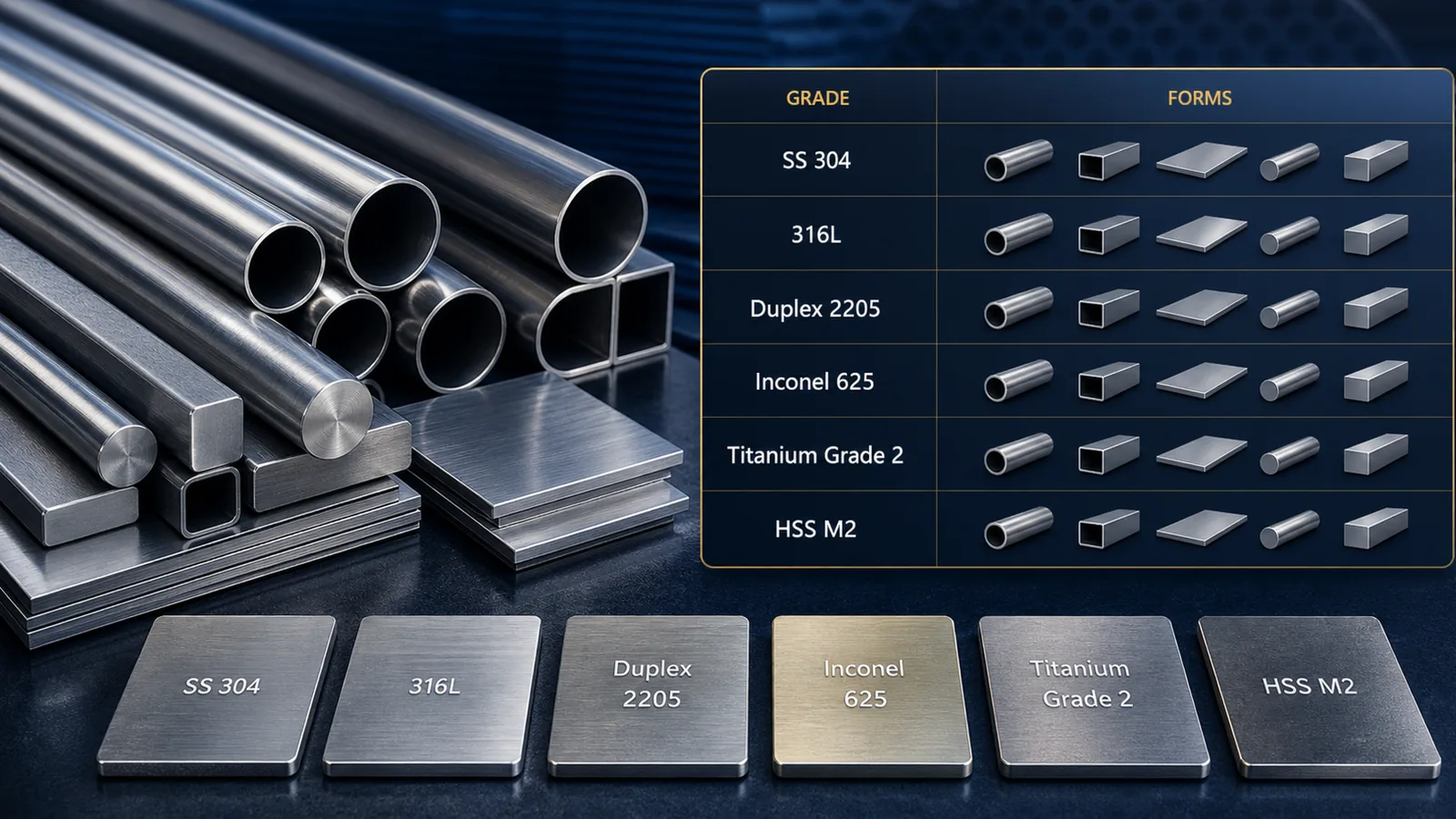
Use this grades hub to review common material grade groups before sending an RFQ. Grade selection should follow buyer drawings, project standards, service conditions, product form, dimensions and documentation requirements.
Austenitic, ferritic, martensitic, heat-resistant, precipitation hardening and specialty stainless grades for specification-led enquiries.
Duplex and super duplex grades are reviewed for strength, chloride exposure, seawater and project specification requirements.
Nickel alloy enquiries often depend on corrosion, heat, chemical processing, marine or exchanger service conditions.
Titanium grade review should consider corrosion exposure, strength, weight, fabrication route and buyer specification.
SMO 254 and 6Mo references are reviewed for high-chloride and corrosion-sensitive applications where specified by the buyer or project engineer.
Aluminium grade selection depends on machining, fabrication, weight, corrosion exposure and strength requirements.
Non-ferrous grade enquiries are reviewed against conductivity, machinability, forming, wear and corrosion requirements.
Carbon steel and mild steel RFQs should include product form, dimensions, standard, mechanical requirement and delivery location.
HSS grade enquiries are reviewed for tooling, machining, cutting and wear-service applications based on buyer specifications.
For grades not listed here, buyers can share the material family, trade reference, UNS/EN/ASTM reference, product form, size, quantity and documentation requirement for review.
Specification-led pipe and structural steel enquiries should include standard, grade, size, wall thickness or section, quantity, testing, documentation and destination details.
Grade suitability depends on service condition, corrosion exposure, temperature, mechanical requirement, fabrication method, standard, project specification and buyer or project engineer review. Rubinox can support RFQ discussion, but final suitability should be confirmed against the buyer's engineering requirement.
Yes. The grade links point to existing Rubinox grade or category pages.
No. Rubinox can support RFQ discussion, but final grade suitability should be confirmed by the buyer, consultant or project engineer.
Buyers should include UNS, ASTM, ASME or EN references in the RFQ where specified by the project.
HSS enquiries such as M2, M35, M42 and T1 can be routed through the high speed steel category page for review.
Buyers should share material, grade or specification, product form, size, quantity, delivery location and documentation requirements so the enquiry can be reviewed clearly.
Rubinox can review PAN India and export enquiries with procurement and documentation details shared by the buyer, subject to material, grade, form and sourcing feasibility.
Use these specification-led resources for project RFQ review alongside grade pages.
Include grade, standard, form, size, quantity and documentation requirements for RFQ review.